

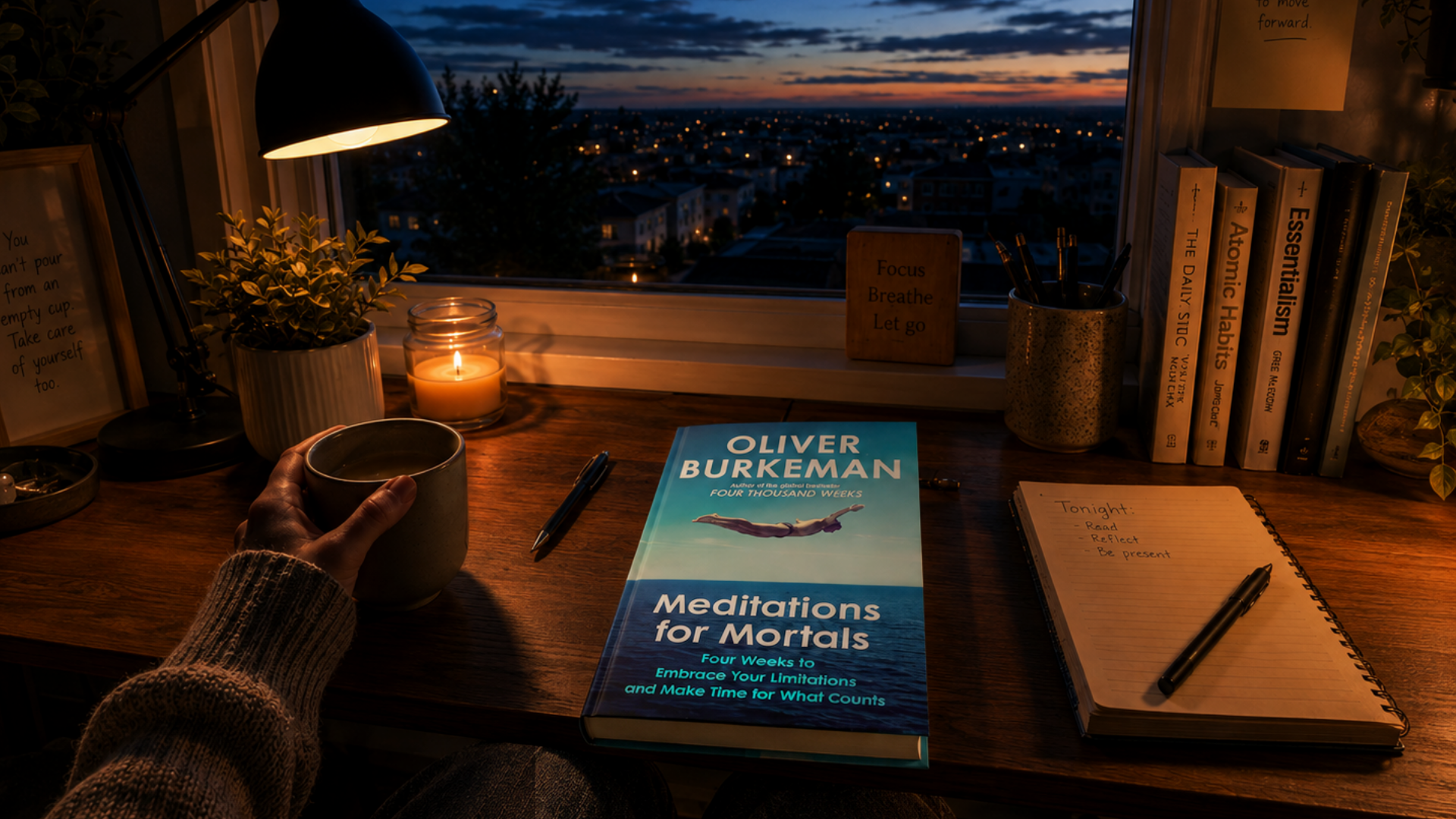
Meditations for Mortals: 7 Life Lessons for Women Over 50
Time is short. Here’s how to stop chasing and start choosing.
At this stage of life, many women find themselves in a quiet reckoning. After decades of caregiving, careers, and keeping everything afloat, there’s a new question rising to the surface: What do I actually want to do with the time I have left?
Oliver Burkeman’s Meditations for Mortals doesn’t give you a list of goals or a roadmap to reinvention. Instead, it offers a more radical suggestion: Stop trying to conquer time. Stop optimizing every minute. Let go of the fantasy that one day you’ll get it all under control. And start living as if time is not simply a resource to manage—but a mystery to honor.

7 Life Lessons from Meditations for Mortals by Oliver Burkeman for Women in Later Life
Here Are the Key Takeaways for LifeShiift Readers
1. You Are Not in Control—and That’s a Good Thing
We’ve been trained to believe that being in control means we’re doing life right. But Burkeman turns that idea inside out.
“To be delighted by another person or moved by a landscape or a work of art, requires not being in full control.”
Letting go of control isn’t failure—it can be the first step toward wonder. And for women who have spent years managing everyone else’s needs, this can feel both foreign and freeing.
2. Forget the To-Do List—Try a Done List Instead
You’ll never finish everything. That’s not a personal shortcoming—it’s a human truth. Burkeman gently reminds us to stop treating life like a giant list of tasks to complete.
Instead, he suggests a done list:
“My favourite way of combating the feeling of productivity debt in everyday life is to keep a ‘done list’—a record not of the tasks you plan to carry out but of the ones you’ve completed.”
For women used to measuring their days in output, this small shift offers a different way to recognize progress and satisfaction.
3. Let Go of the Fantasy of Getting to Everything
We’ve all got a “to-read” pile, a backlog of articles, podcasts, and books we feel we should consume. But Burkeman offers a new metaphor:
“Treat your to-read pile as a river, not a bucket… a stream that flows past you from which you get to pick a few choice items.”
This idea extends to life itself. You don’t need to do it all, see it all, or know it all. In fact, you can resist the urge to stockpile knowledge.
Choose what matters now, and trust that it’s enough.
4. Let the Future Take Care of Itself—Mostly
Women often carry the emotional labor of anticipating every possible future scenario. But Meditations for Mortals reminds us that we can spend less energy trying to control the future and have more faith in our ability to respond when challenges actually arrive.
“You could devote less energy to manipulating the future, and have more faith in your capacity to handle things once the challenge actually arrives.”
What a relief—to release the pressure of pre-solving everything.
5. Decide by Doing
It’s easy to get stuck in the “thinking about it” phase—especially during life transitions. Burkeman’s advice is deceptively simple:
“A decision doesn’t count as a decision until you’ve done something about it in reality—no matter how small.”
A single small step, taken in real life, can be more useful than hours of inner debate. This can be especially meaningful when we’re reinventing ourselves in midlife.
6. Follow the Life Task Calling You Now
Not everything that calls to you needs to be grand. Some desires feel quiet. Some nudges show up in unexpected places. Pay attention.
“A life task is something your life is asking of you.”
It’s about listening. What’s calling you right now? A creative project? A conversation? A long walk by the lake? That could be your life task.
7. Seek Out “Good Difficulty”
Burkeman distinguishes between draining effort and meaningful effort. He calls the latter “good difficulty”—the kind that stretches you.
“Good difficulty enlarges you.”
At LifeShiift, we believe that challenge doesn’t end at retirement—and neither does growth. The key is choosing challenges that matter to you now.
A LifeShiift Perspective
Meditations for Mortals is not a bucket-list book. It’s a mindset shift—an invitation to live more deeply, not more perfectly.
For women over 50, this is a life-giving message. You don’t have to conquer time. You don’t have to fix everything. You don’t have to do it all before sunset.
You just have to pay attention. Let go a little. Choose what—and who—matters. And take that first small, real-world step toward the life that’s calling you now.
Because you’re not here to manage your life. You’re here to live it.
If you’ve read Meditations for Mortals, we’d love to hear: What insight stayed with you the most?





Leave a Reply