
Success in the Next Part of Your Life: Finding Purpose as You Age
What will success mean in the next part of your life?
This very existential question has been on the minds of many LifeShiift members, as expressed in their sign-ups. Some exciting findings and ideas have come forward in exploring this topic, suggesting that the best may still be ahead.
Much of the material for this blog is taken from the book Strength to Strength by Arthur Brooks, which explores ideas about success, happiness, and finding fulfillment in the later stages of life. Some of the thinking is new, while other ideas echo concepts associated with Maslow and his Hierarchy of Needs.
New Vision of Aging
This is a new way to look at the aging process, which has often been visualized as an arc starting at birth, moving upward into middle age, and then moving downward. This visual suggests that everything declines with age and that the best years are behind us.
Brooks talks about aging as a spiral rather than an arc, with our wisdom and experience continuing to develop and change as we age. While some abilities may diminish over time, others can remain strong or flourish.
An important part of this approach is understanding that happiness can involve a combination of purpose, satisfaction, and enjoyment. These elements are not necessarily governed by age. For some people, the ability to pursue a purpose that brings satisfaction and enjoyment can become easier when the need to accumulate things or support a family decreases.
Two Kinds of Intelligence
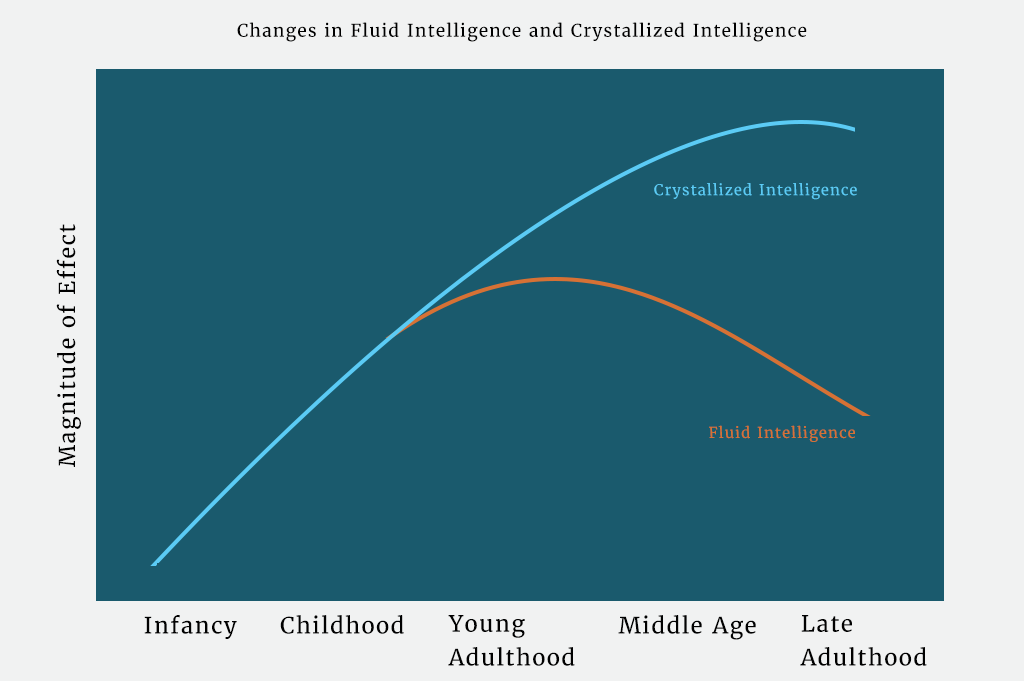
Part of the traditional way of thinking about aging has to do with the two kinds of intelligence that Brooks identifies. These are:
- Fluid intelligence – This is used to solve novel problems and learn new tasks quickly. Think of it as processing speed. Fluid intelligence tends to develop through early adulthood and may decline with age. Think about your ability to learn a new computer program. Fluid intelligence is the intelligence represented by the traditional aging “arc.”
- Crystallized intelligence – This refers to using accumulated knowledge and experience to solve problems. It may not operate as quickly as fluid intelligence, but it can be broader and more informed by experience. It can support becoming a better teacher, asking better questions, and recognizing patterns. Think about the times you have remembered a solution to one problem and successfully applied it to a new situation. Crystallized intelligence can remain strong and may continue developing with age.
The trick to finding purpose and joy in this stage of your life may be to let go of the need to cling to or continually develop the abilities that once came most easily. Instead, recognizing and expanding your accumulated knowledge and experience can help you appreciate what you bring to this stage of life.
Maslow Was Right
If you have ever taken a psychology course or even a business course on motivation, you may recognize similarities to Maslow’s Hierarchy of Needs. Crystallized intelligence can support aspects of self-actualization, as described by Maslow. This is the level associated with moving beyond basic needs and psychological needs toward fulfillment and realizing your potential.
Is now the time for you to move beyond worrying about changes in fluid intelligence and embrace your crystallized intelligence? Could that bring you closer to a sense of fulfillment? Let me know your thoughts on these concepts in the comments below.